Most kids grow up seeing money as a tool for getting what they want. But what if they learned early on that it can do so much more?
Money serves multiple purposes, one of which may be to help others. You could talk about charitable giving at home, but if you’re like most parents, the actual giving happens behind the scenes. Kids often don’t really see it, so it can feel abstract.
To convey this concept, I recently tried something different with my oldest daughter. It was a simple exercise, but it turned out to be surprisingly powerful (for both of us!). If you’re looking for ways to introduce your kids to the philanthropic process—or simply expand their view of money to include more than just themselves—this experience might spark a few ideas and help you create an approach that fits naturally into your own family life.
Need guidance on the best way to achieve your charitable goals? Talk to us at Curio Wealth—we can help you map it out!
Sharing The Philanthropic Process With Tweens
As a member of Anne Arundel Women’s Giving Together, I participate in an annual grant process together with 400+ other women in my community. We pool our collective dollars and annually give away hundreds of thousands of dollars to local organizations that have applied for grants. In the six years I’ve been doing this, it’s been an eye-opening experience for me personally; it’s given me a better understanding of the needs of my community and insight into what makes an effective nonprofit.
This year was different. Instead of making the selections and voting on my own, I presented my nine-year-old daughter with the short list of potential grantees, 10 in total, and asked: Who would you give it to and why?
Needless to say, it was interesting to watch a nine-year-old’s brain work through this process! She read the descriptions of each organization and made a series of notes.

If she knew that a need was already being addressed in some way, such as with free school lunches or food pantries, those requests fell off the list. She also took into consideration whether the organization’s request addressed an immediate need or was trying to get ahead of a future problem. But mostly she followed her heart.
One of her favorites was an afterschool program that transported kids to sports and activities if their home life did not allow that opportunity. She loves doing sports after school and wanted the same for other kids.
In the end, we cast her votes online for a total of five organizations. (With only one vote per member this was an exercise in restraint for me!) I didn’t try to change her vote; I just tried to stay curious and engaged throughout the process. When the final votes were tallied, four of the five organizations that were awarded grants were ones she had chosen—amazing! She felt like her vote truly mattered, and it was a thrill for me, too, to watch her excitement over seeing the results.
You don’t have to be involved in a giving circle to do a version of this exercise in your household.
You could simply hand your child a list of organizations vetted by you; older kids could come up with the shortlist themselves based on their own research and interests. After some discussion, you could decide together where your charitable money will be donated. The goal isn’t to tell them what matters most. It’s to give them a window into the decision-making process and help them see money as a tool for impact, not just consumption.
Reaching Younger & Older Kids
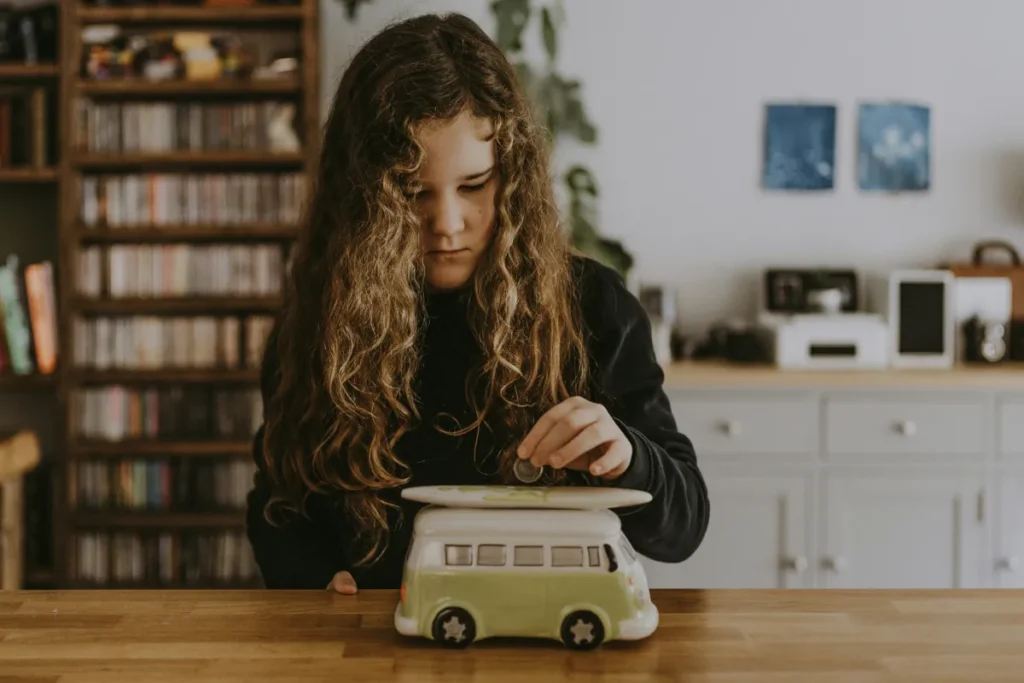
You don’t have to wait until a child is in their tweens to start expanding their thinking about how to use money. When younger children, say ages five to eight, receive money for birthdays or odd jobs, you can easily work the concept into conversation by introducing the idea of “spend, save, and give”—three options for using the cash.
In my family, we like to take the kids to the dollar store with a small bag of loot (ten one-dollar bills). For the spend option, this is a fun way to introduce kids to the idea of purchasing power and the sacrifices that sometimes have to be made to get what you want. (The dollar store is a lot more fun than Target when you only have $10!) If they want to buy something that’s $30, they can opt to save. Or, they might also decide to give it by buying something for one of their siblings or other family members.
Then, if you’ve followed through in the tween years with occasional discussions and experiences like the ones I described above, your teenager will already be primed to think about money in a broader way. Spending is only one of three options.
In today’s climate, having this foundational philosophy to fall back on is even more critical. It’s never been harder to explain how money works now that every transaction is down to the swipe of a card or the click of a “buy” button. With digital payments and one-click purchases, money can feel abstract. Kids can start to see a card or phone as the source of payment, without fully understanding the work and choices behind the money itself. You can combat that slippery slope by proactively talking with your kids about money and giving them a better understanding as to where the household money goes, and (to some degree) your rationale in making those decisions—especially as it pertains to charitable giving.
As parents, we have an opportunity to shape how our kids think about money long before they’re making financial decisions on their own. When we intentionally show them that money isn’t just for buying things—but also for helping others, giving back, and creating joy—we expand their perspective in a way that can last a lifetime.
These lessons don’t have to be complicated; even small, consistent experiences can make a meaningful impact. Because the earlier kids understand that money has many purposes beyond just getting what they want, we give them a stronger foundation for becoming thoughtful, generous, and financially aware adults.