
You spent decades learning how to save for retirement. But what happens when you’re retired and it’s time to do the opposite?
The habits that helped you build your nest egg don’t disappear when you stop working. That’s why, for many retirees, spending doesn’t feel like a reward for years of discipline. It feels like breaking a rule. Instead of fully enjoying the experiences you saved for, you end up putting them off or continually second-guessing the cost.
In essence, your savings are protected but they aren’t enriching your life. That’s not wealth, that’s a life on hold.
Retirement demands a new challenge of you, which is to rethink what progress looks like. It’s no longer just about preserving your savings but about using them to build a life you enjoy.
You can change your mindset by adopting a few new strategies. As you’ll see below, the earlier you start the better!
Need help coming up with a retirement plan that gives you the confidence to spend? Get in touch with us at Curio Wealth!
3 Strategies To Develop A Spending Mindset In Retirement
1. Start flexing your spending muscle before retirement.
If you’ve spent decades focused on saving, you can’t expect spending to feel natural the day you retire. Think of your working years as a kind of financial conditioning: they are an opportunity to build the habits you’ll carry into retirement. That means exercising two muscles—saving for security and using money intentionally to enjoy your life.
One way to practice is to set savings goals for the near- and intermediate-terms in addition to your long-term retirement goals. Perhaps there’s an anniversary trip you’d like to take in two years. Save specifically for it, and when the time comes, practice giving yourself permission to spend that money on its intended purpose.
Then stop and ask yourself: How did that feel?
In our conversations with clients, we often hear that spending feels good when the money has a clear purpose. They set it aside for something meaningful, reached their goal, and used it as planned. Those experiences offer practice for retirement.
Of course, that’s easier when an unexpected expense doesn’t derail your plans. If a broken furnace or car repair forces you to dip into your travel fund, it can reinforce the feeling that spending on yourself is never quite safe. That’s why it’s important to account for both purposes: money that provides security and money that lets you enjoy the things you value. Dedicated emergency savings can help keep those needs from competing.
The goal isn’t to spend more for the sake of it or stretch beyond what you can afford. It’s to get comfortable with the full cycle of setting a goal, saving toward it, and using the money as intended so retirement doesn’t have to be your first time practicing.
2. Get into the habit of planning.
Practicing spending goes hand in hand with practicing planning.
When you save for a trip two years from now, you’re doing more than setting money aside. You’re deciding what you want to do, working out what it will cost, and making room for it in your finances. The plan gives that money a purpose, and gives you a reason to feel comfortable spending it.
Bring that same approach into retirement. Start by mapping out what you expect to spend over the next year or two, including everyday expenses and the experiences or purchases that matter to you. Then look at how that spending fits within your longer-term financial plan. The goal is to enjoy your money today without compromising the security you’ll need down the road.
It’s impossible to say what your spending will be 10 or 15 years from now (though you can usually make a good guess); your near-term spending is easier to bring into focus. Sketch out those numbers in more detail, then stress-test them within your broader plan to see how they hold up under different scenarios.
That’s where planning can help ease the hesitation around spending. Instead of asking, “Can I really afford this?” in isolation each time, you have a framework for answering the question and a clearer understanding of what you can spend with confidence.
3. Create a portfolio paycheck.
Watching your savings balance go down can be uncomfortable, even when you’re using the money exactly as you intended. After years of building your nest egg, each withdrawal may feel like a loss rather than a way to support the life you’ve worked toward.
One way to approach that mindset shift is to create a “portfolio paycheck.” Instead of thinking, “I’m dipping into my savings again,” you can think, “My savings are paying me.” You’re giving your retirement income a familiar rhythm, with money arriving in your bank account on a regular schedule, much like your paycheck did during your working years.
The withdrawals still come from your savings, but the structure can help you view that money differently: your portfolio is doing the job you built it to do.
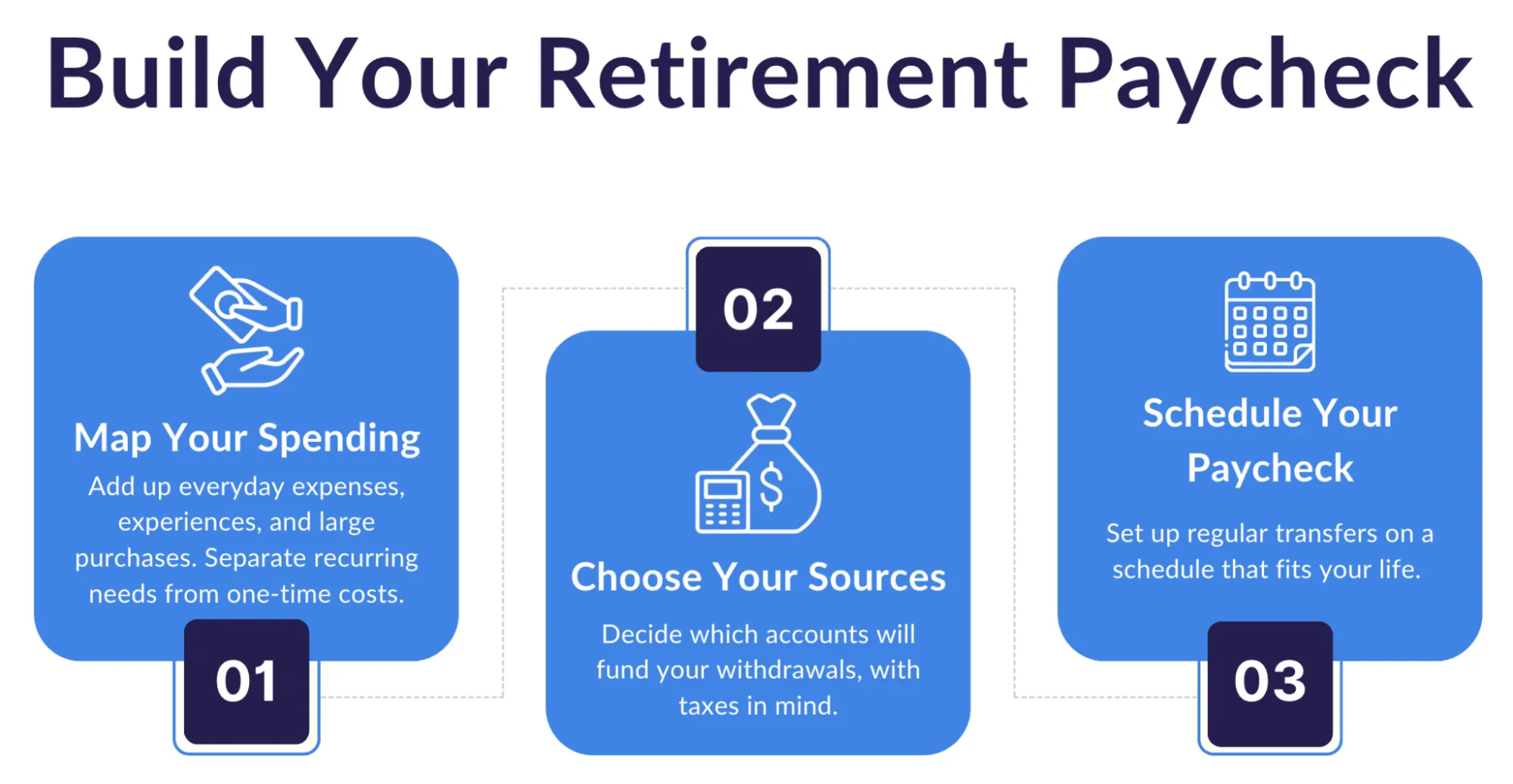
To set up a paycheck structure:
- Start by figuring out what you need. Outline your expected spending for the next year. Include your regular monthly expenses, the activities you want to enjoy, and occasional purchases such as a new car or replacement appliance. From there, determine how much you’ll need your portfolio to provide on a recurring basis and which expenses will require separate, one-time withdrawals.
- Decide where the money will come from. Review the types of accounts you have and how withdrawals from each will be taxed. For example, withdrawals from a 401(k) or IRA are generally taxable as ordinary income. Selling investments in a taxable brokerage account may generate capital gains. Coordinating those sources can help you meet your spending needs while managing the tax impact. Your plan can identify which accounts will fund your regular paycheck and where you’ll turn for larger, less frequent expenses.
- Put your paycheck on a schedule. Work with your account custodian to establish recurring transfers to your bank account. Choose a schedule that feels familiar and fits your expenses, such as monthly or twice a month. Remember to account for taxes, whether through withholding on eligible withdrawals or planned estimated tax payments.
Think of it as reversing the process you followed while saving: instead of automatically moving money into your retirement accounts, you’re arranging for money to come back to you. The purpose is no longer just to build your nest egg. It’s to let that nest egg support you.
Don’t underestimate the importance of a plan.
As you head off into retirement, make sure you have a spending plan in place. It doesn’t have to be perfect to be useful—it’s fine to be approximately right and adjust as you go.
Two important points to consider when planning:
First, build some “cushion” into the plan. A portfolio paycheck can help you feel more comfortable spending in retirement, but when markets fall, that newfound confidence can be tested. How much room will your plan have to absorb a downturn without requiring a change in spending? Some retirees may have enough cushion to continue their planned withdrawals through a substantial decline. Others may have less room and need to adjust spending sooner. A severe downturn can also reduce a cushion that previously felt comfortable.
Second, make sure your portfolio is properly diversified. You need the right mix of stocks and bonds to give yourself the best possible odds of being able to continue to pay yourself as markets do their thing. In some years, stocks will be up and bonds will be down; other years, stocks will be down and bonds will be up. (And in some years, both will be up or down.) Having the proper mix helps manage the volatility in your portfolio and gives you options when withdrawing.
Prepare Now To Enjoy What You’ve Built
Planning, diversification, and a thoughtful paycheck structure all come together to create a system for spending with confidence—and enjoying the experiences you’ve spent years saving for.
That was certainly the case for one of my longtime clients. After nearly a decade of working together, she finally admitted that “the system works.” But the beautiful part was that this confidence opened the door to an experience she’d wanted to have for a very long time: to travel to her family’s homeland, Sicily, for the first time. She eventually took that trip (after we put it in the plan!), and she told me all about it when she returned.
What I didn’t hear was how painful it was to spend the money.
Instead, I heard this: “I wouldn’t trade that experience for anything. It felt like I was going home.”
As an advisor, it was also incredibly fulfilling for me. This is the Curio Wealth way in action: A financial plan that’s uniquely yours based on your money and your goals. We believe wealth is about aligning your resources with what matters most to you. Your retirement plan should help you do both: protect your future and live the life you spent years saving for.
If you need help planning your retirement, don’t hesitate to get in touch. We’d love to get to know you and build a plan together that gives you the confidence to enjoy what you’ve worked so hard to save.