

Retirement is often pictured as a shared milestone: two spouses stepping away from work at roughly the same time and beginning their next chapter together. But for couples with a substantial age gap, this isn’t usually the case. Very often, they face a completely different kind of retirement transition—one that occurs in two phases over a long period of time. Most couples would agree that this type of transition feels less like a single finish line and more like a balancing act.
When one spouse is ready to enjoy retirement and the other still has years of work ahead, making a sound financial plan for the future requires careful thought and special planning. I’ve helped many couples navigate the decisions that arise when retirement timelines don’t align. Here’s my advice on how to think about this transition, and how to build a financial plan that supports both partners’ priorities today while helping protect your long-term security as a couple.
Are you facing this unique retirement planning challenge? Contact us at Curio Wealth and let’s talk!
In traditional retirement planning where both spouses stop working at once, household income changes and the couple typically begins living on a clearly defined retirement budget. But when one spouse retires years before the other, there may be a long in-between period—sometimes a decade or more—when one person is drawing on retirement resources while the other is still earning a paycheck. In this scenario, the biggest challenge is to figure out how to make your retirement dollars last longer overall, but still allow the first spouse to take advantage of the freedom and opportunities of retirement now.
This was the topic of conversation in my office recently with a couple trying to plan around their 12-year age gap. The husband (in his mid-fifties) planned to retire in less than five years, while the wife expected to spend the next 12 years or more in the workforce. Currently healthy and active, he wants to be able to enjoy and explore during the early years of his retirement. He also wants to ensure that his wife will be taken care of by the time she reaches retirement age. What could they do to make their resources support both outcomes?
For couples in this situation, the key is to stop viewing retirement as one event and start viewing life as a series of financial phases. Doing so gives you a high-level view of how your expenses may change over time, allowing you to better predict your future financial needs. Incorporating major life events into the phases brings the picture into even sharper focus, giving you a clear view of what you can realistically do in each phase to help support the next.
The progression could look like this:
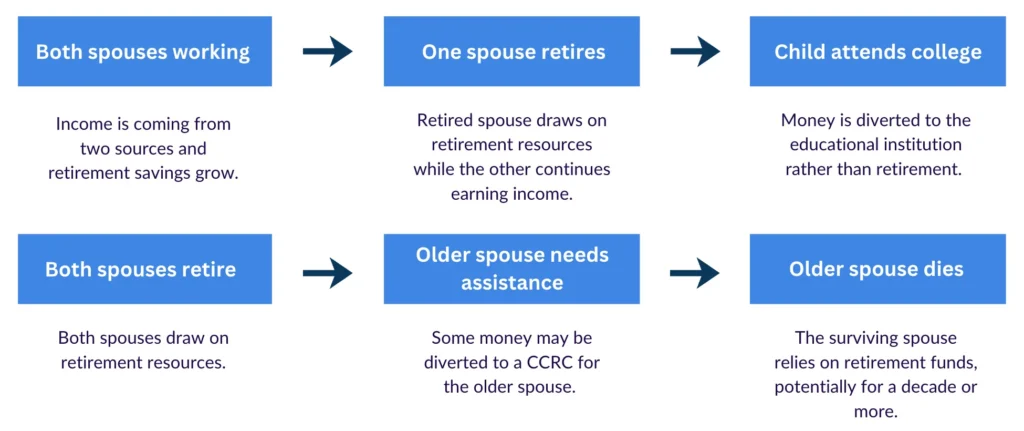
All of the above transitions may seem straightforward, but every couple will handle them differently. For example, if you want to travel or buy a second home during your early retirement phase, will your still-working spouse travel with you—or live, even part-time, at the second home? And if you are the younger partner, what will you do if your spouse moves to a continuing care community—will you go, too? These are not always easy conversations, but they allow couples to define what an ideal future looks like for each person and build a plan designed to protect both partners through every phase. Mapping those periods out can make a long-range plan feel more concrete because it reveals when income, savings, spending, and priorities may shift.
Create A Plan, Then Stress-test It
Mapping out the phases allows you to start building a tentative financial plan around them. The goal is not to predict the future perfectly. It’s to use the information you have today (your expected retirement dates, income, savings, college plans, spending goals, and hopes for later life) to make an educated guess about what the years ahead may look like financially.
Naturally, you’ll start by modeling the plan under ordinary assumptions. What does cash flow look like while both spouses are still working? How does it change when one spouse retires and the household goes from two incomes to one? If college costs overlap with those early retirement years, how much will need to come out of pocket, and how might that affect retirement contributions or spending? Then look ahead to the point when both spouses are retired, along with the years that may follow.
But life rarely goes exactly as expected. That’s why it helps to stress-test the plan with different variables. What if one spouse dies earlier than anticipated? What if the younger spouse lives to age 100? What if a child chooses a more expensive college, or one spouse needs long-term care sooner than expected? Running through these possibilities is not about assuming the worst. It’s about understanding where the plan could come under pressure and identifying potential responses before those circumstances arise.
Those responses will look different for every couple because everyone has their own priorities and “non-negotiables.” Some people have a firm, non-negotiable retirement date, for example. Sometimes, you may need to make adjustments in other areas to make that happen. As a couple, you’ll need to decide the best course of action according to your priorities. You could:
- Increase your rate of savings (and lower your expenses), which might involve lowering your standard of living for the next four to five years.
- Extend the retirement timeline for the second partner.
- Strive for an increase in the working partner’s income.
- Consider part-time or flexible work in retirement.
- Reduce the cost of college by choosing a less expensive school, or getting scholarships or student loans.
- Put off some of your other goals like big anniversary trips or remodeling your house.
- Be more aggressive in the stock market. (However, this strategy goes against the common-sense approach of reducing your risk the closer you get to retirement.)
A couple may decide that retiring on a particular date matters more than taking bigger trips, buying a second home, or completing a major renovation. Or they may decide that working longer would give them more freedom to spend and enjoy retirement later.
A Plan Built Around You
The important thing to remember throughout this exercise is that the variables, assumptions, and stress tests should be tailored to you as a couple. They should reflect your life and priorities. A good financial advisor can help uncover those priorities (even if you haven’t identified them yet yourself) and guide you in developing a financial plan that reflects the version of your future you want to see, not that we as advisors believe is the right path.
At Curio Wealth, we don’t presume to know what’s best for you. The only assumption we start with is that you are unique. We listen and observe closely in our early conversations to learn: What are your priorities? Which uncertainties keep you up at night? What trade-offs are you willing—or unwilling—to make? Our objective is to create a financial plan that helps you see the versions of your future that matter most to you. As a result, you’ll come away with a practical, personalized tool that will help you make confident decisions through all phases of life.